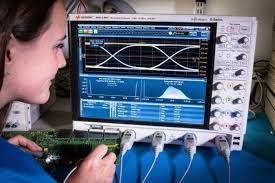
Oscilloscopes are indispensable diagnostic instruments used in electronics design, troubleshooting, power analysis, and verification of complex digital and analog signals. Their accuracy directly affects engineering decisions, safety evaluations, and compliance documentation. Over time, internal components drift due to thermal cycling, mechanical stress, and electronic aging. Oscilloscope calibration restores precise measurement performance, ensuring that voltage amplitude, time base, frequency, rise time, and triggering characteristics remain traceable to national standards.
Why Oscilloscope Calibration Is Essential
An uncalibrated oscilloscope can introduce measurement errors that propagate through an entire design or test process. Even a small deviation in vertical or horizontal scaling can distort signal interpretation, leading to incorrect assumptions about noise, timing margins, or transient behavior. Industries such as aerospace, medical device manufacturing, telecommunications, and semiconductor development depend on accurate waveform analysis to validate product reliability.
Calibration providers like SIMCO perform oscilloscope calibration under controlled environmental conditions using precision reference standards. Their expertise helps organizations maintain measurement confidence across daily operations.
Common Sources of Oscilloscope Drift
Several factors degrade oscilloscope performance:
● Component aging: Reference oscillators, amplifiers, and ADCs shift over time.
● Thermal variation: Temperature cycling affects clock stability and gain stages.
● Mechanical stress: Connectors, knobs, and switches wear with use.
● Firmware updates: Software changes can affect calibration settings.
Manufacturers typically recommend annual oscilloscope calibration, although high-demand environments may require shorter intervals.
What Is Included in Oscilloscope Calibration?
Calibration follows procedures aligned with ANSI/NCSL Z540, ISO/IEC 17025, and manufacturer specifications. The process involves several steps:
1. Visual and Functional Inspection
Technicians inspect connectors, probes, buttons, internal components, and display performance. Damaged probes or loose BNC connectors often lead to measurement inconsistencies.
2. Warm-Up Period
Before calibration, oscilloscopes must stabilize for up to 30 minutes to ensure thermal equilibrium. Skipping this stage can produce incorrect readings.
3. Vertical System Calibration
Reference voltage sources are applied to verify:
● Gain accuracy
● Offset accuracy
● Bandwidth response
● Linearity
Technicians adjust internal parameters when deviations exceed allowable tolerances.
4. Horizontal System Calibration
Time base calibration verifies:
● Clock accuracy
● Sweep linearity
● Delay accuracy
Precision frequency standards ensure accurate timing measurements across all ranges.
5. Trigger System Verification
Trigger sensitivity and stability determine how reliably the oscilloscope captures intermittent events. Calibration confirms correct triggering on edge, pulse, and complex waveforms.
6. Documentation and Certification
Upon completion, a detailed calibration certificate records measurement results, uncertainties, and adjustments performed. This documentation is essential for quality audits, regulatory compliance, and engineering records.
Maintaining Long-Term Signal Integrity
Proper oscilloscope calibration ensures confidence in waveform analysis, reduces false troubleshooting steps, and supports product safety validation. When paired with preventive maintenance, calibration extends instrument life and reduces costly downtime.
SIMCO provides comprehensive oscilloscope calibration for a wide range of models, ensuring that laboratories maintain traceable measurement performance.