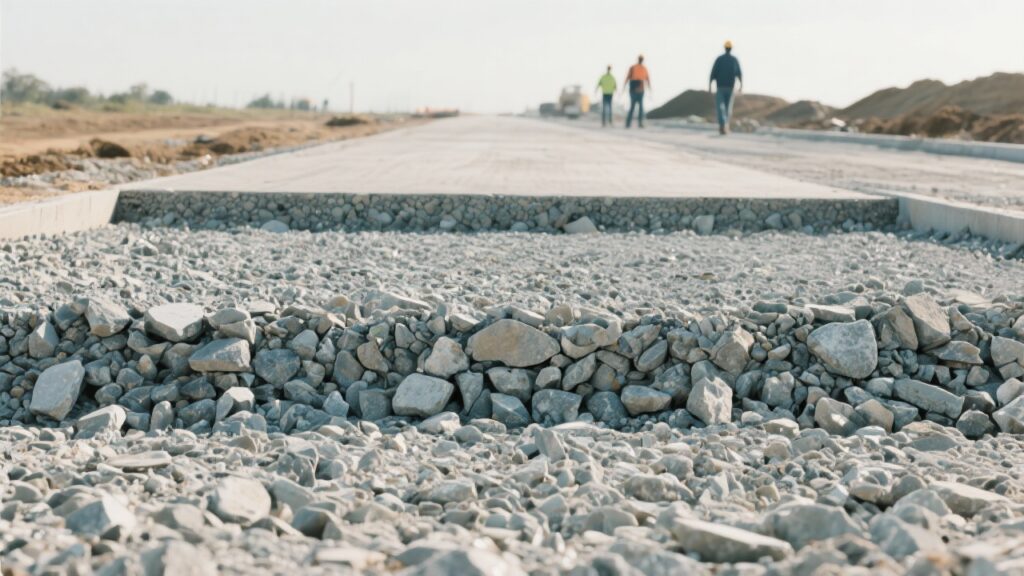
Civil engineers face mounting pressure to deliver infrastructure projects that balance performance requirements, budget constraints, and environmental sustainability. Recycled concrete aggregate (RCA) has emerged as a proven solution for road base applications, offering comparable or superior performance to virgin materials while reducing project costs and environmental impact. The key to successful implementation lies in understanding RCA properties, processing requirements using equipment like a rock crusher, and proper specification development. This guide provides civil engineers with the technical knowledge needed to confidently specify and implement recycled concrete aggregate in road base materials applications, ensuring projects meet all performance standards while advancing sustainable pavement construction goals.
Understanding Recycled Concrete Aggregate: Properties and Performance
Before specifying RCA in road base applications, engineers must understand how this material differs from conventional aggregates and what performance characteristics it offers.
What Makes RCA Different from Virgin Aggregate
Recycled concrete aggregate consists of crushed concrete from demolished structures, pavement, and construction waste. Unlike virgin aggregate quarried from natural deposits, RCA contains residual cement paste adhered to the original aggregate particles. This cement paste coating typically comprises 25-40% of RCA volume, fundamentally affecting material properties. The paste creates a more angular particle shape with increased surface roughness compared to many natural aggregates. While this might seem disadvantageous, the angularity actually enhances interlocking and shear strength in compacted base applications. Understanding these compositional differences is essential for proper material specification and quality control.
Physical and Mechanical Properties of Recycled Concrete Aggregate
Extensive research and field performance data demonstrate that properly processed RCA meets or exceeds requirements for road base materials. California Bearing Ratio (CBR) values for well-graded RCA typically range from 80-150%, comparable to high-quality crushed stone. The Los Angeles Abrasion test results for RCA usually fall between 30-45%, within acceptable limits for base course applications per AASHTO M147 specifications. Specific gravity of RCA ranges from 2.2-2.5, slightly lower than virgin aggregate due to cement paste porosity, but this difference has minimal impact on structural performance. Absorption rates of 3-8% are higher than virgin aggregates, requiring moisture management attention during construction but providing beneficial internal curing properties in concrete applications.
Gradation and Density Characteristics
Proper gradation is critical for RCA road base performance. Well-graded RCA following AASHTO specifications for dense-graded aggregate base provides optimal load distribution and minimizes settlement. Processing quality directly impacts gradation consistency—modern crushing and screening operations produce RCA meeting tight specification bands. Maximum dry density of RCA typically ranges from 125-140 pcf, within the acceptable range for structural base courses. The slightly lower density compared to some virgin materials is offset by excellent compaction characteristics. RCA achieves 95-98% relative compaction readily with standard construction equipment, making it contractor-friendly while meeting stringent density requirements.
Engineering Benefits of RCA in Road Base Applications
Beyond environmental advantages, RCA offers specific engineering benefits that improve pavement system performance.
Load-Bearing Capacity and Structural Performance
Field performance monitoring of roads with RCA base courses demonstrates excellent load-bearing capacity over extended service periods. The angular particle shape and strong interlocking create high shear strength, critical for resisting lateral movement under traffic loads. Studies comparing pavements with RCA versus virgin aggregate bases show equivalent or lower rutting rates after 5-10 years of service. The residual cement paste, while affecting some properties, contributes to cementation over time through continued hydration, potentially increasing strength in the long term. Engineers can confidently design pavements with RCA bases using the same structural coefficients applied to high-quality crushed stone bases.
Drainage Properties and Permeability Advantages
The porous nature of cement paste in RCA creates beneficial drainage characteristics. Permeability testing shows that RCA base courses typically exhibit higher drainage coefficients than dense-graded virgin aggregates, ranging from 200-800 ft/day depending on gradation. This enhanced drainage capability helps manage subsurface water, reducing moisture-related distresses like pumping and frost heave. For sustainable pavement construction projects incorporating permeable pavement systems, RCA serves as an ideal base material. The combination of structural capacity and drainage performance makes RCA particularly suitable for projects where water management is critical to long-term performance.
Long-Term Durability in Pavement Systems
Durability concerns about RCA have been thoroughly addressed through decades of field performance data. Roads constructed with RCA bases in the 1980s and 1990s continue performing well, demonstrating material stability over multiple decades. Freeze-thaw testing of RCA shows acceptable durability when sourced from quality concrete and properly processed to remove contaminants. The key to durability is source material quality—RCA from high-strength concrete (4,000+ psi) exhibits better long-term performance than material from lower-strength sources. Proper specification of source concrete requirements ensures durable road base materials that maintain structural integrity throughout design life.
Meeting DOT Specifications with Recycled Concrete Aggregate
Successful RCA implementation requires compliance with agency specifications and quality standards.
AASHTO and State DOT Standards for RCA Road Base
AASHTO has established clear guidance for recycled materials in pavement construction through specifications like M319 (Reclaimed Concrete Aggregate for Unbound Soil-Aggregate Base Course) and PP64 (Percent Embedment for Reclaimed Concrete Aggregate). Most state DOTs now include RCA specifications, though requirements vary. Common specifications limit deleterious materials (wood, asphalt, metals) to 0.5-2% by weight, require minimum CBR values of 80-100, and set maximum absorption limits of 6-10%. Engineers should review specific state DOT specifications early in project development, as approval processes and testing requirements differ significantly among jurisdictions. Many agencies now actively encourage RCA use through sustainability scoring in project evaluation or by setting minimum recycled content requirements.
Quality Control Testing Requirements
Comprehensive testing ensures RCA meets performance requirements. Standard tests include gradation analysis (AASHTO T27), Los Angeles Abrasion (AASHTO T96), CBR testing (AASHTO T193), specific gravity and absorption (AASHTO T85), and soundness testing (AASHTO T104). Contamination screening through visual inspection and deleterious materials quantification is essential. Testing frequency typically follows the same protocols as virgin aggregate—initial characterization testing followed by ongoing quality control at specified production intervals. For projects using RCA, engineers should specify testing at the processing facility rather than relying solely on field testing, ensuring material quality before delivery to the project site.
Certification and Documentation for Project Approval
Proper documentation streamlines project approval and reduces risk. Certification should include source material information (structure origin, original concrete strength, age), processing method documentation, and complete test results against specification requirements. Many successful projects include approved source lists identifying acceptable demolition sources and processing facilities. Engineers should establish clear chain-of-custody documentation tracking material from source through processing to placement. This documentation not only ensures specification compliance but also provides valuable data for performance monitoring and future projects. Comprehensive records support agency acceptance and provide liability protection for all project stakeholders.
Cost-Effective Road Construction: Economic Analysis of RCA
Economic advantages often drive initial RCA consideration, but comprehensive cost analysis reveals multiple savings mechanisms.
Direct Cost Comparison: RCA vs. Virgin Aggregate
Material cost represents the most obvious economic advantage. RCA typically costs $8-15 per ton compared to $15-25 per ton for virgin aggregate, representing 30-50% direct savings. For a typical one-mile road reconstruction requiring 5,000 tons of base material, this translates to $35,000-85,000 in material cost savings. These savings increase in regions where virgin aggregate is scarce or transportation distances are long. Market dynamics vary regionally, but the cost advantage is nearly universal. Even in areas with abundant natural aggregate, processing demolition concrete into RCA proves more economical than quarrying, crushing, and hauling virgin material.
Transportation and Logistics Savings
Transportation frequently represents 40-60% of delivered aggregate cost. RCA processing facilities located near urban centers, where most demolition occurs, dramatically reduce hauling distances. A project sourcing virgin aggregate 50 miles away versus RCA from 10 miles away saves $3-7 per ton in transportation alone. This proximity advantage compounds economic benefits while reducing traffic congestion, fuel consumption, and carbon emissions. For large projects, transportation savings can exceed direct material cost savings, making cost-effective road construction with RCA compelling even before considering environmental benefits.
Life-Cycle Cost Analysis for Pavement Projects
Comprehensive economic analysis extends beyond initial construction costs. Life-cycle cost analysis comparing RCA and virgin aggregate bases shows equivalent or lower total costs over 30-40 year analysis periods. The comparable or superior drainage characteristics of RCA potentially reduce maintenance requirements related to moisture damage. Early replacement of failed pavements represents one of the largest life-cycle costs—field performance data showing equivalent longevity for RCA bases confirms that initial cost savings don’t come at the expense of long-term performance. For agencies pursuing value engineering and sustainable pavement construction, life-cycle analysis strongly supports RCA specification.
Design Considerations for Sustainable Pavement Construction
Proper design accommodates RCA characteristics while maximizing performance benefits.
Structural Design Parameters for RCA Base Courses
Pavement design using RCA base courses follows standard mechanistic-empirical procedures with appropriate material properties. For structural analysis, engineers can apply resilient modulus values of 25,000-40,000 psi for well-compacted RCA base, equivalent to high-quality crushed stone. Layer coefficient values of 0.12-0.14 are appropriate for RCA base courses in AASHTO pavement design methods. Some agencies conservatively reduce coefficients by 10% for initial RCA projects, though field performance data suggests this conservatism is unnecessary. The key is using appropriate compaction specifications—achieving 95% relative compaction ensures structural parameters match or exceed design assumptions.
Layer Thickness Requirements and Compaction Standards
RCA base course thickness design follows conventional approaches, typically ranging from 6-12 inches depending on traffic levels and subgrade conditions. Minimum thickness should be 6 inches for proper aggregate interlock and load distribution. Compaction is achieved through standard methods—vibratory rollers, smooth-drum rollers, and pneumatic tire rollers all perform effectively. The slightly higher absorption of RCA requires moisture management during compaction. Optimal moisture content typically ranges from 6-10%, somewhat higher than virgin aggregates. Field density testing should be performed at the same frequency as for conventional base materials, with acceptance criteria of 95% minimum relative compaction and moisture within ±2% of optimum.
Integration with Various Pavement Types
RCA performs excellently as road base materials under flexible (asphalt), rigid (concrete), and composite pavement structures. For flexible pavements, the enhanced drainage characteristics help prevent moisture-related distresses. In rigid pavement applications, RCA provides uniform support while the higher permeability aids in controlling curling and warping stresses. Composite pavements benefit from both advantages. Engineers should consider drainage design carefully—while enhanced permeability is generally beneficial, edge drains and proper grading prevent moisture accumulation that could affect performance in frost-susceptible regions.
Best Practices for Specifying and Implementing RCA in Projects
Successful implementation requires careful attention to specification development and stakeholder communication.
Writing Effective Project Specifications
Clear, performance-based specifications ensure quality while allowing contractor flexibility. Specifications should address source material requirements (minimum original concrete strength, maximum contaminant levels), gradation requirements referencing AASHTO standards, minimum CBR or resilient modulus values, absorption limits, and compaction requirements. Including approved source lists or approval procedures for new sources streamlines bidding. Many agencies find that referencing state DOT standard specifications for RCA, with project-specific modifications, provides tested language while maintaining consistency across projects. Performance specifications focusing on outcomes rather than prescriptive processes encourage innovation while ensuring results.
Addressing Stakeholder Concerns
Education is critical for stakeholder acceptance. Some owners and engineers remain skeptical about recycled materials despite extensive performance data. Presenting case studies from similar projects in the region, providing test data demonstrating specification compliance, and offering pilot sections for performance monitoring build confidence. Contractor education on handling, placing, and compacting RCA prevents construction issues. Pre-construction meetings addressing RCA-specific considerations ensure all parties understand material characteristics and construction requirements. Transparency about what RCA is, where it comes from, and how it performs addresses concerns proactively.
Future of Recycled Aggregates in Transportation Infrastructure
The trajectory for RCA in infrastructure construction points toward expanded adoption and enhanced performance.
Emerging technologies in concrete aggregate specifications and processing continue improving RCA quality and consistency. Advanced crushing technologies produce more cubical particles with improved gradation control. Contamination removal systems using optical sorting, air classification, and magnetic separation create cleaner final products. These processing improvements expand RCA applications beyond road base into higher-value uses like structural concrete.
Regulatory trends increasingly favor recycled materials. Federal infrastructure funding programs now include sustainability requirements that benefit RCA projects. State legislatures mandate minimum recycled content in public works projects. Carbon reduction mandates make the lower embodied energy of RCA increasingly valuable. As climate considerations become central to infrastructure decision-making, materials like RCA that reduce carbon footprint while maintaining performance will become standard rather than alternative solutions.
Conclusion: Engineering Sustainable Infrastructure with RCA
Recycled concrete aggregate represents proven technology for road base applications, offering civil engineers a solution that simultaneously addresses performance, cost, and sustainability requirements. Decades of research and field performance confirm that properly specified and constructed RCA base courses equal or exceed virgin aggregate performance. The engineering properties, economic advantages, and environmental benefits make RCA the logical choice for modern sustainable pavement construction projects.
For civil engineers committed to delivering high-performing, cost-effective infrastructure, RCA deserves serious consideration in every project involving road base materials. The extensive specification guidance, performance data, and field experience available today eliminate the uncertainty that might have existed in earlier years. By specifying recycled concrete aggregate, engineers advance both project success and professional responsibility for sustainable infrastructure development.