Key Takeaways
- Noise, vibration, bounce, and payload movement often begin with impacts between casters and uneven travel surfaces.
- R.T. Laird, Inc. focuses on shock-absorbing caster designs intended to manage deflection and reduce shock transfer.
- Proper caster selection depends on the load, floor condition, operating speed, mounting arrangement, wheel requirements, and environment.
- Noise-reduction performance should be evaluated in the actual application rather than assumed from a product description alone.
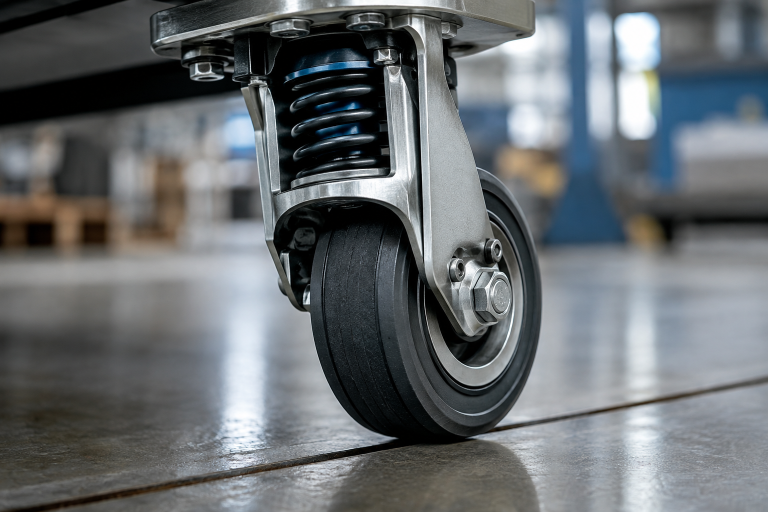
When standard casters create excessive rolling noise, vibration, shimmy, or dynamic bounce, the solution may require more than a basic replacement wheel. A properly selected noise reducing caster can help equipment move more smoothly by managing the shock generated when wheels encounter seams, thresholds, cracks, joints, ramps, and other uneven surfaces.
R.T. Laird, Inc. specializes in shock-absorbing and shock-isolating casters for industrial and specialized equipment. Its approach centers on controlled spring deflection, helping reduce the abrupt forces that can travel from the floor through the caster, equipment frame, and payload. The right result depends on the complete application, including the equipment’s weight, travel pattern, floor surface, and performance priorities.
Why Conventional Casters Can Create Noise and Shock
Every moving caster encounters some level of surface variation. On a smooth floor, the effect may be minor. On imperfect surfaces, a rigid caster system can transmit impacts directly into the equipment. That transfer can create audible rolling noise, frame vibration, rattling components, payload movement, and greater stress on mounting hardware.
Conventional spring caster systems may have limited deflection and a spring response that rises sharply near the beginning or end of travel. When a wheel strikes an obstacle or drops onto an uneven surface, the impact may cause the equipment to accelerate, bounce, or resonate. These effects can be especially troublesome for heavily loaded carts, mobile platforms, instruments, vehicle-mounted equipment, and systems that move frequently.
Common Signs of a Caster Performance Problem
- Loud rolling or impact noise at floor joints, thresholds, or expansion seams.
- Shimmy, flutter, or unstable steering while equipment is in motion.
- Dynamic bounce after crossing an obstruction.
- Loose fasteners, stressed mounts, or repeated wheel and bearing maintenance.
- Movement or vibration of fragile, sensitive, or high-value payloads.
- Resonance that makes the equipment frame or surrounding components vibrate.
How R.T. Laird, Inc. Uses Deflection to Improve Movement
R.T. Laird, Inc. designs shock-absorbing casters around a wide deflection range and gradual spring rates. In practical terms, the caster is intended to absorb more of the movement induced by uneven surfaces rather than transmit the full impact to the equipment. This can help reduce vibration, noise, shimmy, dynamic bounce, and resonance when compared with a rigid or limited-travel caster arrangement.
The difference can be understood as a comparison of operating behavior:
- Deflection range: A conventional caster may offer limited travel, whereas a shock-absorbing design is designed to operate over a broader range of controlled movement.
- Spring response: A high-rate response can create a sharper impact. A gradual response is intended to manage load changes and surface impacts more smoothly.
- Surface irregularities: Rigid systems may transfer more force to the cart or vehicle. A shock-isolating caster is designed to help isolate the load from that force.
- Noise and vibration: Reducing abrupt mechanical impact can also help reduce the vibration and noise associated with movement.
Noise Control Is Part of a Larger Workplace Strategy
Casters can be a useful point of intervention when mobile equipment contributes to workplace noise, but they are not a substitute for a complete noise assessment or hearing conservation program. Engineering controls that address noise at its source are an important part of workplace noise management, particularly when mechanical impacts and vibrating equipment are contributing to the problem.
For caster-related concerns, a practical assessment should identify when the noise occurs, where the equipment travels, what load it carries, and whether the sound is accompanied by vibration or instability. Maintenance conditions also matter. Worn wheels, damaged bearings, loose mounting hardware, and degraded floor surfaces can all affect performance.
Applications That May Benefit from Shock-Reducing Casters
R.T. Laird, Inc. supports applications where controlled movement and payload protection are important. A shock-absorbing caster may be considered for:
- Manufacturing equipment: Fixtures, tooling carts, mobile production equipment, and work platforms.
- Fragile instruments: Equipment that requires reduced shock and vibration during relocation.
- Defense and aerospace systems: Specialized equipment with demanding payload, movement, or surface conditions.
- Medical and laboratory equipment: Mobile systems where smooth transport and stability are priorities.
- Material-handling equipment: Carts and platforms that cross thresholds, joints, ramps, and inconsistent floors.
- People-moving platforms: Applications where user comfort, stability, and controlled movement matter.
How to Prepare a Noise-Reducing Caster Request
An application-focused request gives R.T. Laird, Inc. the details needed to review whether a shock-absorbing caster design is appropriate. Include the following information:
- The equipment type, overall dimensions, and intended use.
- Total operating weight, number of casters, and estimated load carried by each caster.
- Floor material, travel route, and the largest seams, thresholds, gaps, or obstacles.
- Expected travel speed, distance, frequency, and whether the load changes during operation.
- The primary concerns are noise, vibration, payload protection, bounce, shimmy, or operator comfort.
- Mounting dimensions, clearance limits, wheel preferences, and brake or swivel requirements.
- Environmental conditions, including moisture, temperature, chemicals, outdoor exposure, or washdown requirements.
- Existing caster failures, maintenance history, photographs, measurements, or sound observations.
How to Evaluate Results After Installation
A successful selection should be measured against defined conditions. Compare equipment before and after installation on the same route, at similar speeds, and with comparable loads. Useful observations include sound level readings, vibration measurements, payload movement, visible bounce, steering stability, fastener condition, and wheel or bearing service intervals.
Broader occupational noise data can provide useful context, but site-specific testing remains essential. The occupational noise exposure matrix developed through NIOSH research includes 989,179 valid measurements across 274 industries and 430 occupations, illustrating the value of measurement when evaluating workplace noise conditions.
When to Contact R.T. Laird, Inc.
Direct consultation is especially valuable when a standard catalog caster does not address the full scope of the operating challenge. Contact R.T. Laird, Inc. when equipment carries high or changing loads, the payload is sensitive, floors are rough or inconsistent, travel is frequent, clearance is limited, or the existing caster system produces repeated noise and vibration problems.
Frequently Asked Questions
Can shock-absorbing casters reduce equipment noise?
They are designed to reduce the vibration and shock transfer that can contribute to rolling noise. Actual results depend on the load, wheel material, floor condition, speed, equipment structure, and maintenance condition.
Can these casters help protect fragile payloads?
A properly selected shock-absorbing caster may help limit abrupt impacts and dynamic bounce transferred to the payload. The caster must be matched to the equipment, load distribution, movement conditions, and required level of isolation.
What is the main advantage of an application-specific caster review?
An application review considers how the caster behaves in the real operating environment rather than selecting solely by load capacity. This helps align the caster system with the equipment’s movement, surface, mounting, and payload-protection requirements.
Start With the Complete Operating Picture
Noise, vibration, bounce, and payload stress are often connected. When conventional casters create those problems, R.T. Laird, Inc. offers a focused approach based on shock isolation and controlled deflection. Providing complete application details is the strongest first step toward selecting a caster system that supports smoother movement, better stability, and reduced shock transfer.